|
Until 2014, the information below explained the best way to get started playing basic simplified guitar chords with a partial capo. Now with the introduction of the amazing new Liberty Tuning, it's all changed, and beginners now have a very exciting new set of options. With a Liberty Model 43 capo (and a full capo to match your voice) you can pretty much play any song you want to with simple 2-finger chords on any guitar. The musical options are incredible: no hard stretching, almost no added or missing notes in the chords, fewer strings to avoid, more choices of keys to play in... It only takes 5 or 10 seconds to do it with any guitar-- there is no tuning that is any easier to do, and there is nothing anywhere that works like it does. Harvey Reid has now published 9 books that detail carefully how it works and how any level of player can enjoy its magic. If you already play guitar and don't need beginner assistance, read on...
Getting Started With A Partial Capo
Since the partial capo is useful for
beginners and amateurs as well as professional guitarists, it can be confusing to figure out where to start. Having a partial capo can be frustrating because it
it not at all obvious how to use it to make your music sound better. Here are some suggestions for beginners,
songwriters and serious players of how to get going.
 BEGINNERS BEGINNERS
If you have never played guitar,
a partial capo is your "backstage pass" to get you playing great-sounding music right away. Probably
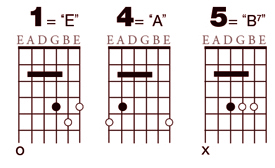
the easiest and most effective starting point is the E-Suspended or "Esus" configuration. Either an Esus (3-string) capo or a Universal model will get you going instantly playing in the key of E. The "E" chord
is actually an "E5" modal
chord, the "A" chord is an "A add9" and the "B7" is a "B7sus" but for a
lot of songs they function as 1, 4 and 5 chords and will sound fine. In many cases they actually sound better than "normal" E,
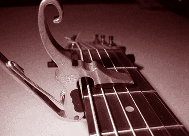
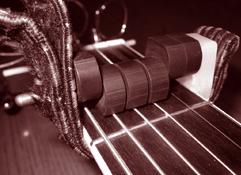
A and B7 chords, depending on the song. The one-finger chords you need are shown here, and three types of partial
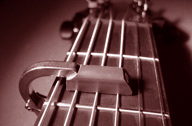
capos that will do the job are also shown 1) The Kyser
Short Cut 2) the Third
Hand 3) the Shubb
c7b
:   
The Duck
Soup Guitar
book has 29 children's songs and shows 6 ways to use a partial capo to play "instant guitar." The
larger Song
Train (http://www.songtrain.net ) is a 4-CD set with an
80-page hardback book that is designed to get people going playing basic guitar. It also shows how to use a
partial capo in a number of ways, and offers 56 great songs (including rock, country, folk, gospel, blues,
bluegrass and folk songs) that anyone can play right away.
SINGERS & SONGWRITERS
If you already play songs
on your guitar, you can quickly get new chord voicings and some fuller-sounding chords with a partial capo. Because
the partial capo "world" is so different, it's good to start with a couple easy ones to get the feel
for it before trying the more confusing configurations, even if you are a skilled player. Probably the first thing
you should try is to see if you have a clamp-style capo (such as a Shubb, Kyser, G7, Sabine,
Planet Waves or Dunlop Trigger)
that you can just offset to on side so that it clamps 0 2 2 2 2 2 like this. You can also move
it to the 4th fret and play 0 4 4 4 4 4 and quickly adapt to the new situation. Our new Capo
Voodoo book shows over 1200 chords and 24 different ways to put a 3-string Esus capo on your guitar.

On
a lot of guitars, a normal full capo can do this, and you can begin exploring partial capo-ing without buying
anything. Read this discussion about partial capo basics that
carefully takes you through exactly what is going on.
You will also probably have an immediate
good time by playing in D position with an Esus capo toi get new sounds in the key of E.
SERIOUS
GUITARISTS
If you already play guitar well, you can
jump in a number of different places. You should be able to start playing music in the Drop E configuration right
away, and chances are there is something you are already playing in D position, either with or without a Dropped
D tuning, that will benefit from the partial capo. You can then try capo 0
4 4 4 4 4 and play in C position easily
also .
If
you are skeptical that a partial capo has any real "value," take
a look at this "Half-Open A" ( 0
2 2 2 0 0) arrangement
of the 2-part round Frere Jacques. Try to play this piece in standard tuning without the partial capo.
It's a good example of how the different landscape the capo offers sometimes allows the notes you want to play
to be much easier to reach. Naturally, there will be just as many situations where it will make it harder, but
it is indisputable fact that an inexpensive, small, durable tool like this can indeed open up new and very
real musical possibilities to any player.
If
you are a bluegrass player, you might want to next try 0
0 2 2 2 2 , which only a few partial capos can do properly. (Shubb and Kyser both make versions of this, though they don't work well for this purpose on most guitars.The Liberty FLIP Model 43 does it best, and the Planet Waves Trio is 2nd best, though the Liberty 43 is also the best Esus capo.) If you play folk or celtic
music, an Esus (short for E suspended) capo 0
2 2 2 0 0 is probably the best starting point, since it sounds a lot like the common DADGAD
tuning,even though it is a little more confusing at first.
|