Your
best site for understanding the remarkable musical power of partial capos. Capos, books, ideas, explanations, advice, tips, tricks, etc. Enjoy
your visit.
Harvey's ground-breaking discovery of what he calls "Liberty Tuning" has spawned 2 new capos, a new web site, 9 books (paper & iBook) and 2 new recordings. www.LibertyGuitar.com
We create and sell books and videos and recordings that use partial capos.
We no longer manufacture and distribute the Third Hand Capo.
We present the only thorough history of this amazing idea.
If you are a guitar teacher, I can show you some surprising ways a partial capo can help you and your students.
Using a partial capo creates open-string effects similar to those achieved by non-standard tunings of the guitar. Changing the length of an open string with a partial capo yields a similar kind of musical results as you get by retuning. It is, however, fundamentally different than retuning the guitar, and you usually can't play the same music both ways. Since most players generally stay in standard tuning when using a partial capo, the geometry of the scales and chords on your fingerboard remains familiar. This is the primary advantage of using a partial capo. You get more sound from the skills you already have.
You can play many things just as you would in standard tuning, but can achieve some of the sound of a new tuning.Partial capos give you access to a shadowy musical workd in your fingerboard that is not the same as those you can reach with tunings. And if you do both together (hybrid tunings) Look Ou! Most of the truly remarkable partial capo ideas involve using an altered tuning also.
Partial capos are equally valuable to a total beginner, a recreational player, songwriter, or to a serious guitarist or composer. They allow drone-string resonances and chord voicings that are very useful and desirable, and open up a new world of guitar sounds to be explored by both serious guitarists and people who just accompany songs with their guitar. There are thousands of chord voicings suddenly available that no one has ever played before.
There are many interesting and very useful ways to use a partial capo and an altered tuning simultaneously. Even if you are experienced with tunings, the place to begin understanding the surprisingly confusing world of partial capos is to think of it as a "parallel universe" to the world of altered tunings. Start with standard tuning configurations before you "jump off the cliff" and do both at once. There are over 11 million ways to partially capo a guitar in each different tuning! Only a few of them have real musical value, but it's a vast world to explore.
If you are the kind of player who has found uses for altered or open tunings, then it is almost certain that you will find uses for a partial capo.
A partial capo allows you to play good-sounding things on your guitar that are not possible any other way
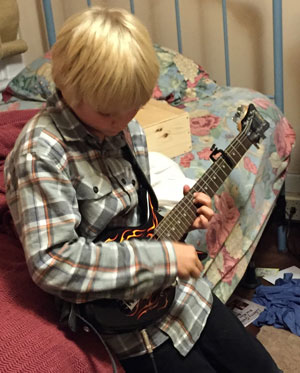
It is also an extremely useful tool for teaching guitar, and allows young children and those with learning disabilities to have a very successful guitar experience. It may be the best way ever devised for teaching fingerpicking.
About me.. I have been using various kinds of partial capos for both songs and instrumentals in my music since the mid 1970's, and I am probably the first modern person to write, publish and record music for the partially-capoed guitar. I won the National Fingerpicking Guitar Contest in 1981 (without using one) and since then have recorded nearly 200 songs and instrumentals in several dozen different capo configurations. I have done thousands of concerts using them, and I probably know more about this mysterious subject than anyone. I want to be your guide to this fascinating musical world, to show you what they can do for your music, help you find the capos that work best for you, and help you learn to use them. There is a surprising amount of misinformation and confusion about partial capos, and many a great guitarist has failed to see their musical valueright away. I am trying to assemble the information, tools and instructional materials that can open up this amazing new world of music hiding inside every guitar.
I have been working for several years on a series of books that show how to use the various types of partial capos, and trying to assemble a lot of information and contacts here in this web site...The first 5 Capo Voodoo books are now done! and available in our store and also worldwide from Amazon.com. They are now iPad digital books. Please look around this web site and see what you can find. What seems to be a harmless guitar gadget is actually a surprisingly deep subject that will keep you busy for decades...
We sell many types of partial capos and materials. We also write and publish books of arrangements for partially capo-ed guitar.

 Hello
from your host Harvey Reid... Here at PartialCapo.com –
Hello
from your host Harvey Reid... Here at PartialCapo.com – Using a partial capo creates open-string effects similar to those achieved by non-standard tunings of the guitar. Changing the length of an open string with a partial capo yields a similar kind of musical results as you get by retuning. It is, however, fundamentally different than retuning the guitar, and you usually can't play the same music both ways. Since most players generally stay in standard tuning when using a partial capo, the geometry of the scales and chords on your fingerboard remains familiar. This is the primary advantage of using a partial capo.